A great croissant is one of the most technically demanding things a baker can make. It requires precision, patience, and a deep understanding of how butter and dough interact under pressure and heat. It also requires three days.
Our croissant process begins on a Wednesday afternoon for Friday morning's bake. This is not inefficiency — it's intention. The extended process allows for controlled fermentation, proper gluten development, and the kind of layering that produces a croissant with 27 distinct, shatteringly crisp layers.
Day 1: The détrempe
We begin by making the base dough — the détrempe — from flour, milk, sugar, salt, yeast, and a small amount of butter. The dough is mixed until smooth, then shaped into a rectangle and refrigerated overnight. The cold rest allows the gluten to relax and the yeast to begin a slow, flavour-developing fermentation.
Day 2: Lamination
This is the heart of the process. We take a block of high-fat European butter (84% fat content — significantly higher than standard butter) and beat it into a flat, pliable sheet. The butter sheet is then enclosed in the dough, and the lamination begins.
Lamination is the process of folding butter into dough repeatedly to create alternating layers. We perform three 'turns' — each turn folding the dough into thirds, like a letter. Between each turn, the dough rests in the fridge for 30 minutes to keep the butter cold and prevent it from absorbing into the dough.
After three turns, the dough contains 27 layers of butter and 27 layers of dough. These layers are what create the characteristic flakiness of a croissant — in the oven, the water in the butter converts to steam, puffing each layer apart.
Day 3: Shaping and baking
On the morning of the bake, we roll the laminated dough to a precise 4mm thickness and cut it into triangles. Each triangle is rolled from the base to the tip, then curved slightly to form the classic crescent shape. The shaped croissants proof at room temperature for 3 hours — long enough to puff up, but not so long that the layers lose definition.
They go into the oven at 190°C for 18 minutes. The first 8 minutes are the most dramatic: the butter steams, the layers separate, and the croissant nearly doubles in height. The final 10 minutes develop the deep amber colour and caramelised flavour that makes a great croissant unmistakable.
The result is a croissant that shatters when you bite into it, reveals a honeycomb of airy layers inside, and leaves a trail of flakes down your shirt. We consider that a success.
ORDER FRESH TODAY
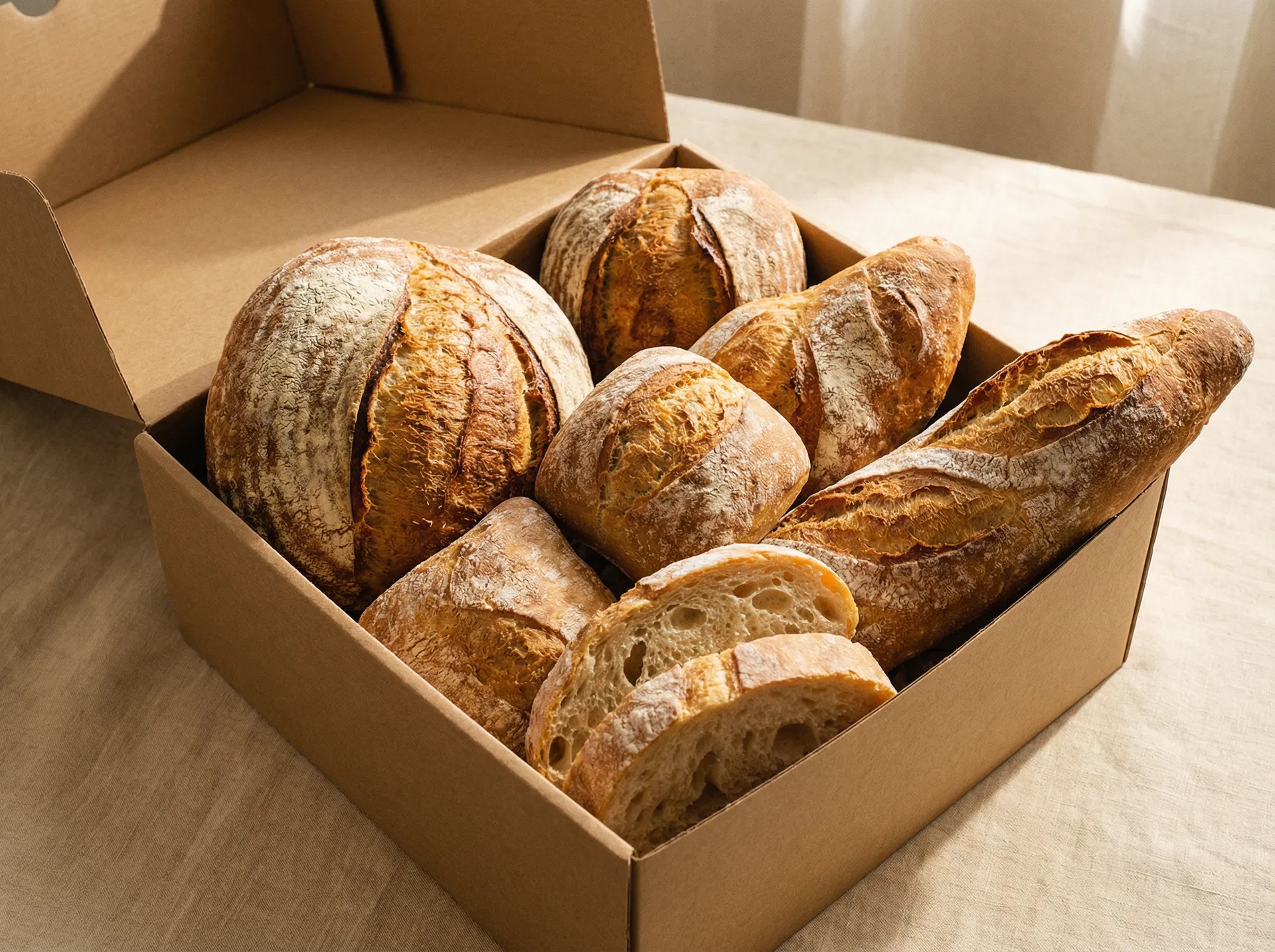
Inspired to taste the real thing? Order a delivery box and get fresh bread at your door.
Shop Now